

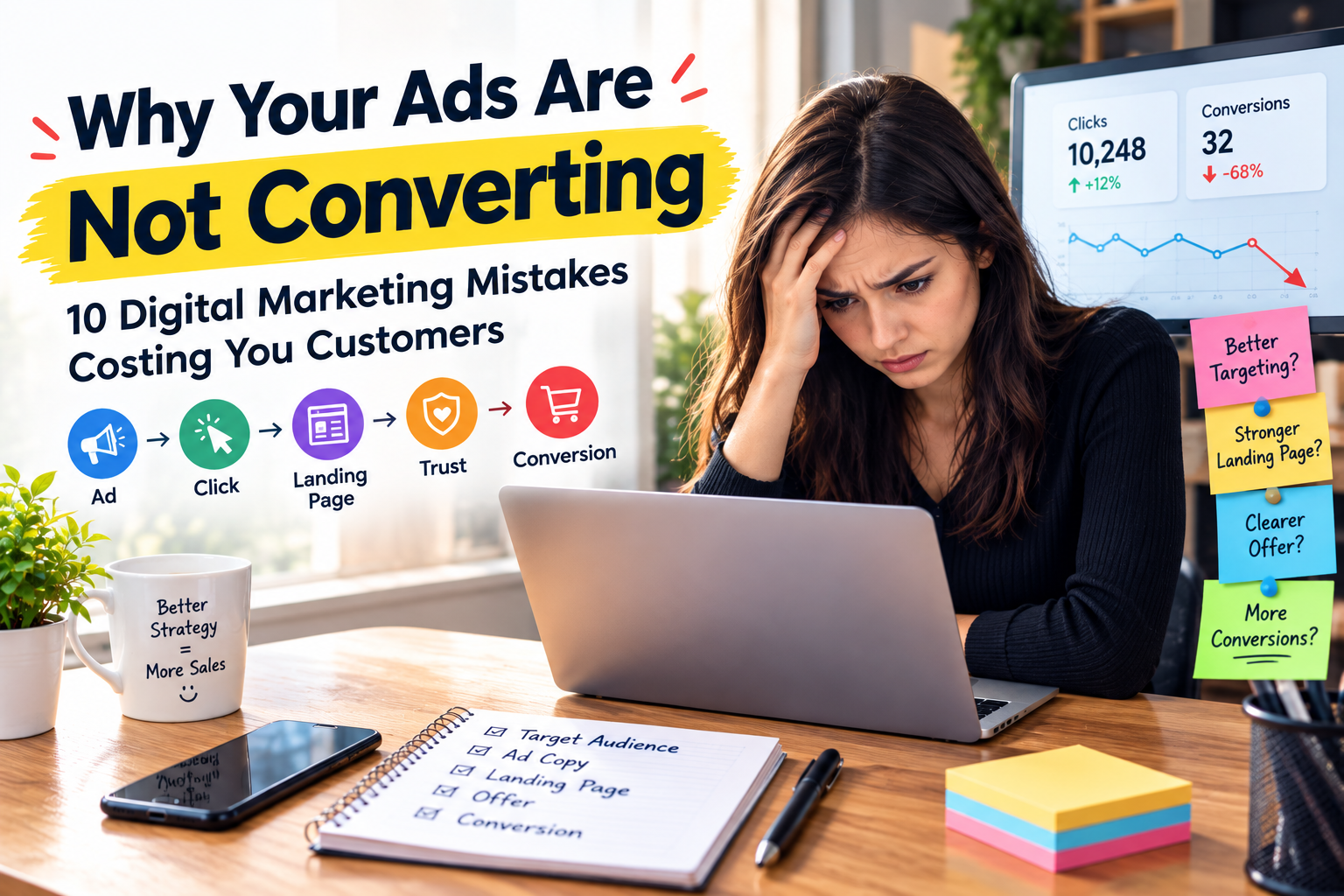
SEO Title: Why Your Ads Are Not Converting: 10 Digital Marketing Mistakes
Focus Keyword: Ads Not Converting
Meta Description: Are your ads not converting? Discover 10 common digital marketing mistakes that can waste your ad budget and learn practical ways to improve conversions.
URL Slug: ads-not-converting
Your Ads Are Getting Clicks… So Why Aren’t You Getting Customers?
You launched the campaign.
People are clicking your ads.
Your analytics show traffic.
But sales? Leads? Sign-ups?
Almost nothing.
If your ads are not converting, increasing your advertising budget may not solve the problem. In many cases, the issue is somewhere between the ad, the landing page, the offer, and the customer’s buying journey.
The good news is that conversion problems can often be identified by looking at the complete customer journey rather than focusing only on clicks.
10 Digital Marketing Mistakes | What Does “Ads Not Converting” Mean?
When an ad gets clicks but fails to generate the desired action, such as a purchase, lead, registration, booking, or inquiry, the campaign may have a conversion problem.
A useful way to think about the funnel is:
Ad → Click → Landing Page → Offer → Trust → Conversion
If one part of this journey creates friction, your campaign can generate traffic without generating enough results.
10 Reasons Your Ads Are Not Converting
| Problem | What It Can Cause | What to Check |
|---|---|---|
| Wrong Audience | Low-quality traffic | Targeting |
| Weak Hook | Low engagement | Ad message |
| Poor Offer | Low buying intent | Value proposition |
| Wrong Landing Page | Visitors leave | Page relevance |
| Slow Website | Higher abandonment | Page speed |
| Weak CTA | No clear next step | Call-to-action |
| Lack of Trust | Customer hesitation | Reviews & proof |
| Poor Mobile Experience | Lost mobile users | Mobile layout |
| Wrong Campaign Objective | Misaligned optimization | Campaign settings |
| No Testing | Missed opportunities | A/B testing |
Let’s look at each problem.
1. You’re Targeting the Wrong Audience
One of the biggest reasons ads fail is reaching people who are unlikely to become customers.
A large audience is not necessarily a good audience.
For example, if you sell professional accounting software to small businesses, showing your ads to everyone interested in “business” may generate clicks but not necessarily qualified leads.
Your targeting should reflect the people who actually have the problem your product or service solves.
Consider:
- Location
- Age where relevant
- Interests
- Behaviors
- Job roles
- Business type
- Purchase intent
- Previous website activity
The exact targeting options depend on the advertising platform.
2. Your Ad Hook Is Too Weak
People scroll quickly.
If your first line does not communicate relevance or create curiosity, users may ignore the ad.
A strong ad hook should quickly answer:
What is this about?
Who is it for?
Why should I care?
Instead of a generic message like:
“Get our marketing service today.”
A more specific message could communicate a customer problem:
“Spending money on ads but getting no leads?”
The second approach immediately connects with a specific pain point.
3. Your Offer Isn’t Clear
People need to understand what they are getting.
If an advertisement promotes a product or service but does not clearly explain the value, users may click without having enough reason to take the next step.
A strong offer should make the value easy to understand.
Ask:
- What exactly are you offering?
- Who is it for?
- What problem does it solve?
- What makes it different?
- What does the customer receive?
- What should the customer do next?
Clarity can reduce friction.
4. Your Landing Page Doesn’t Match the Ad
This is a major issue.
Imagine your ad promises:
“Get a Free SEO Audit.”
But after clicking, the visitor lands on a generic homepage with no mention of the audit.
The visitor now has to search for what they originally wanted.
That extra friction can reduce conversions.
Your landing page should maintain a strong connection between the advertisement and the page.
Ad promise → Landing page message → Offer → CTA
The closer these elements are aligned, the clearer the user journey becomes.
5. Your Website Is Too Slow
A visitor may leave before your page even finishes loading.
Website performance matters because users expect pages to load quickly, especially on mobile devices.
Check:
- Page loading speed
- Image sizes
- Unnecessary scripts
- Hosting performance
- Mobile performance
- Core Web Vitals
A beautiful landing page is not useful if potential customers abandon it before they can read the offer.
6. Your Call-to-Action Is Weak
After someone understands your offer, they need to know what to do next.
A vague CTA can create hesitation.
Examples of clearer CTAs include:
- Get Your Free Quote
- Start Your Free Trial
- Book a Consultation
- Download the Guide
- Get the Offer
- Request a Demo
The CTA should match the action you actually want the visitor to take.
7. Your Page Doesn’t Build Enough Trust
People may hesitate to buy from a business they do not trust.
Trust can be especially important when asking customers for money, personal information, or a long-term commitment.
Depending on your business, useful trust signals can include:
- Customer reviews
- Testimonials
- Case studies
- Clear contact information
- Transparent pricing
- Guarantees where appropriate
- Security information
- Professional branding
- Relevant credentials
Do not use fake reviews or exaggerated claims.
Trust should be earned through evidence.
8. Your Landing Page Is Not Mobile-Friendly
A significant portion of online traffic can come from mobile devices.
If your landing page looks good on desktop but is difficult to use on a phone, you may lose potential customers.
Check:
- Font size
- Button size
- Page spacing
- Form usability
- Image display
- Navigation
- Loading speed
Always test the complete conversion process on an actual mobile device.
9. Your Campaign Objective May Be Wrong
Different advertising platforms provide different campaign objectives and optimization settings.
If your actual goal is generating leads but your campaign is optimized primarily for another type of action, the traffic you receive may not align with your business objective.
Before launching a campaign, clearly define the desired conversion:
Purchase? Lead? Registration? Booking? Download?
Then make sure your tracking and campaign setup support that goal.
10. You’re Not Testing Your Campaign
One version of an ad is not enough to tell you what works.
Testing can help identify differences in:
- Headlines
- Images
- Videos
- Ad copy
- Offers
- CTAs
- Landing pages
- Audiences
For example, you could test two different hooks while keeping the rest of the campaign similar.
Over time, the data can help you identify which elements contribute to better performance.
Clicks vs Conversions: What’s the Difference?
Getting clicks does not automatically mean your campaign is successful.
| Metric | What It Tells You |
|---|---|
| Impressions | How often your ad was shown |
| CTR | How often people clicked |
| CPC | Average cost per click |
| Landing Page Views | Whether visitors reached the page |
| Conversion Rate | Percentage completing the desired action |
| CPA | Cost per acquisition/conversion |
| ROAS | Revenue relative to advertising spend |
A campaign can have a strong CTR but a weak conversion rate.
That may indicate that the ad attracts attention but the landing page, offer, targeting, or customer journey needs improvement.
How to Improve Ads That Are Not Converting
Instead of immediately increasing the budget, diagnose the funnel.
Start with the advertisement.
Ask whether the hook is relevant to the target audience.
Then examine the landing page.
Does it deliver what the ad promised?
Next, evaluate the offer.
Is the value clear?
Then check trust.
Does the visitor have enough information to feel comfortable taking the next step?
Finally, review your analytics and conversion tracking to determine where users are dropping off.
A Simple Ad Conversion Audit
Use this checklist before spending more money:
| Question | Yes/No |
|---|---|
| Is the target audience clearly defined? | ☐ |
| Does the ad address a specific problem? | ☐ |
| Is the offer immediately clear? | ☐ |
| Does the landing page match the ad? | ☐ |
| Does the page work well on mobile? | ☐ |
| Is the website reasonably fast? | ☐ |
| Is there a clear CTA? | ☐ |
| Are trust signals visible? | ☐ |
| Is conversion tracking working? | ☐ |
| Have different versions been tested? | ☐ |
If several answers are “No,” you may have found areas worth improving.
SEO Keywords for This Topic
Primary Focus Keyword:
- Ads Not Converting
Secondary Keywords:
- ads not converting
- why ads are not converting
- digital marketing mistakes
- low conversion rate
- improve ad conversion
- ad conversion rate
- digital advertising mistakes
- PPC mistakes
- landing page conversion
- conversion optimization
Long-Tail Keywords:
- why are my ads not converting
- why Facebook ads are not converting
- why Google Ads are not converting
- how to fix ads that are not converting
- how to improve ad conversion rate
- why ads get clicks but no sales
- how to convert ad traffic into customers
- common digital marketing mistakes
- how to improve landing page conversions
Use the focus keyword naturally in the introduction, SEO title, URL, one relevant heading, and conclusion. Avoid repeating it unnaturally.
Frequently Asked Questions
Why are my ads getting clicks but no sales?
Clicks show that people are interested enough to visit, but they do not guarantee purchase intent. The problem could be targeting, the offer, landing page, pricing, trust, or the overall conversion process.
Why are my Facebook ads not converting?
Possible reasons include weak targeting, an unclear offer, poor creative, weak landing pages, insufficient trust signals, or incorrect conversion tracking. The exact cause should be identified from campaign and website data.
How can I improve my ad conversion rate?
Improve audience relevance, strengthen the ad message, align the landing page with the advertisement, clarify the offer, improve the CTA, add appropriate trust signals, and test different campaign elements.
Should I increase my ad budget if conversions are low?
Increasing the budget does not automatically fix a conversion problem. It is usually more useful to identify and address the bottleneck first.
What is a good conversion rate?
There is no universal conversion rate that is good for every campaign. Results vary by industry, offer, traffic source, audience, device, price, and conversion type. Compare performance with your own historical data and relevant benchmarks.
Final Thoughts
If your ads are not converting, the solution may not be to spend more money.
Your campaign could have a problem with targeting, messaging, offer clarity, landing-page experience, trust, mobile usability, tracking, or testing.
Think beyond the click.
The real journey is:
Attention → Click → Landing Page → Trust → Action
When every stage supports the next one, your advertising becomes easier to diagnose and improve.
Don’t just chase more clicks. Build a customer journey that gives those clicks a reason to convert.