

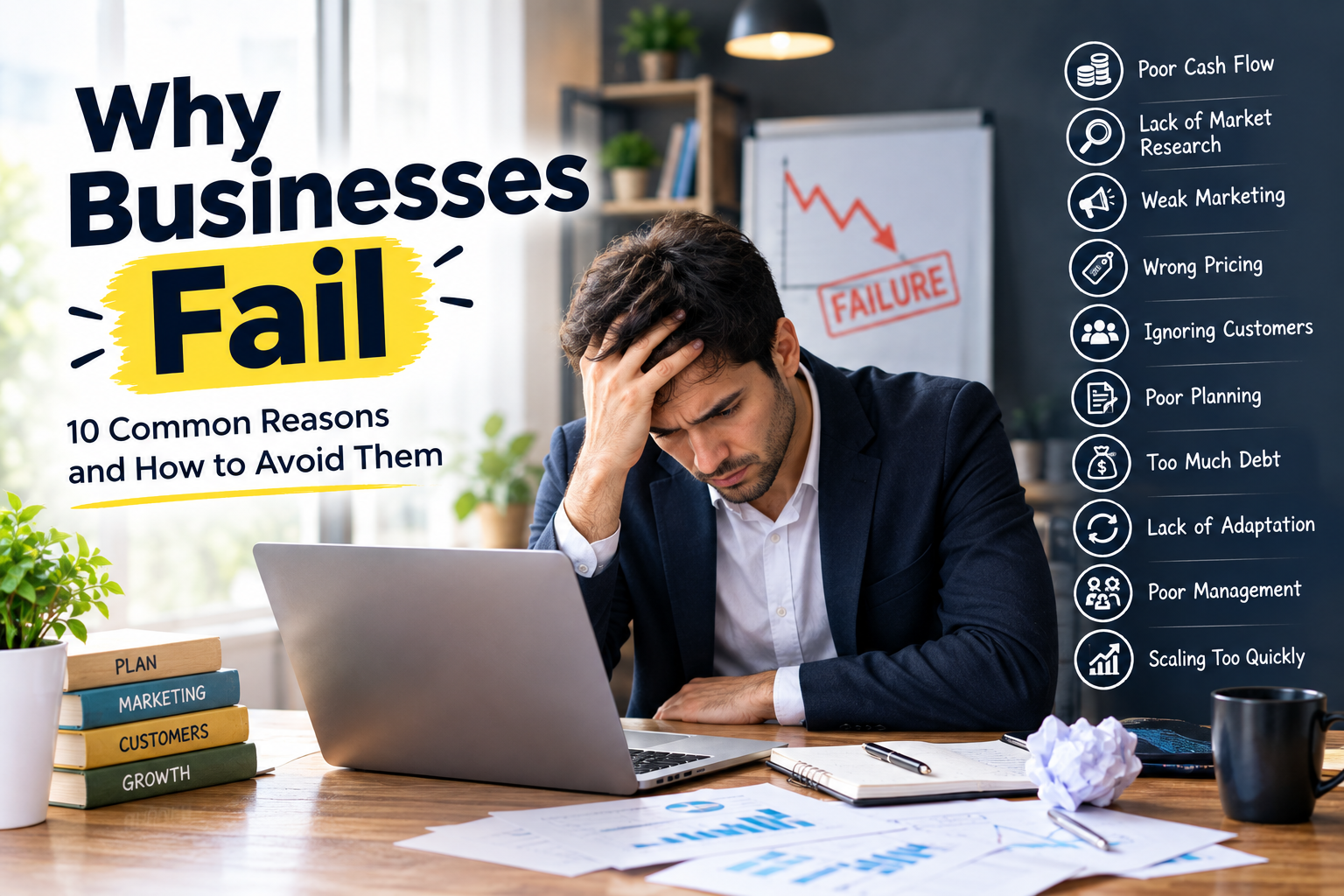
Why Businesses Fail: 10 Common Reasons and How to Avoid Them
SEO Title: Why Businesses Fail: 10 Common Reasons and How to Avoid Them
Focus Keyword: Why Businesses Fail
Meta Description: Discover why businesses fail, from poor cash flow and weak marketing to lack of planning and customer understanding, and learn how businesses can avoid common mistakes.
URL Slug: why-businesses-fail
Why Do So Many Businesses Fail?
Starting a business can be exciting.
You have an idea, a product, or a service that you believe customers will love. But having a good idea is only the beginning.
A business can fail even when the product is good.
Why?
Because business success depends on much more than the idea itself.
Cash flow, customers, pricing, marketing, competition, planning, management, and adaptability can all affect whether a business survives and grows.
Understanding why businesses fail can help entrepreneurs identify problems before they become serious.
What Does Business Failure Mean?
Business failure generally means that a business is unable to continue operating sustainably.
This can happen for different reasons.
A company may run out of cash, lose customers, face excessive debt, fail to adapt to market changes, or struggle to generate enough revenue to cover its costs.
Not every business closure means the same thing. Some entrepreneurs voluntarily close businesses that are not meeting their goals, while others may be forced to shut down because of financial difficulties.
10 Common Reasons Why Businesses Fail
| Reason | What Can Happen |
|---|---|
| Poor Cash Flow | Business cannot cover expenses |
| Lack of Market Research | Product does not match demand |
| Weak Marketing | Potential customers never discover the business |
| Poor Pricing | Revenue or margins are insufficient |
| Ignoring Customers | Customers move to competitors |
| Bad Financial Planning | Costs become difficult to manage |
| Too Much Debt | Repayments create financial pressure |
| Lack of Adaptation | Business becomes less relevant |
| Poor Management | Operations become inefficient |
| Scaling Too Quickly | Expenses grow faster than revenue |
Let’s examine these problems in more detail.
1. Poor Cash Flow Management
One of the most important reasons businesses fail is poor cash flow management.
A business can make sales and still experience financial problems if cash is not available when bills, salaries, suppliers, or other expenses need to be paid.
Revenue and cash flow are not the same thing.
For this reason, business owners should monitor money coming in and going out rather than focusing only on sales.
A simple cash-flow forecast can help identify potential shortages before they become emergencies.
2. Lack of Market Research
A business idea may sound excellent but still fail if customers do not want the product or service.
Market research helps entrepreneurs understand:
- Who the customers are
- What problems they have
- What they currently buy
- How much they may be willing to pay
- Who the competitors are
- What makes the business different
Before investing heavily in a new business, it is useful to test whether real customers are interested.
3. Weak Marketing Strategy
Even a strong product can struggle if potential customers do not know it exists.
Marketing helps a business communicate its value and reach the right audience.
Depending on the business, marketing may include:
- SEO
- Social media
- Email marketing
- Content marketing
- Paid advertising
- Influencer marketing
- Partnerships
- Referral marketing
The key is not simply doing more marketing. It is reaching the right audience with the right message.
4. Poor Pricing
Pricing is another major factor in business sustainability.
Some businesses set prices too low because they want to attract customers quickly.
But if the price does not cover costs and provide a sustainable margin, increasing sales may not solve the underlying problem.
Other businesses may price products too high without communicating enough value.
Effective pricing requires understanding costs, customers, competitors, positioning, and perceived value.
5. Ignoring Customer Feedback
Customers provide valuable information about what is working and what is not.
If a business consistently receives complaints about the same issue but does nothing, customers may eventually choose competitors.
Customer feedback can help businesses improve:
- Products
- Services
- Pricing
- Customer support
- Website experience
- Delivery
- Communication
Listening to customers does not mean accepting every request. It means identifying recurring problems and deciding which improvements make business sense.
6. Poor Financial Planning
Without financial planning, business owners may not know how much money they need to operate, how much they can spend, or when they may face financial pressure.
A basic business financial plan should consider:
Revenue: How much money is expected to come in?
Expenses: What does the business need to spend?
Profit: What remains after expenses?
Cash Flow: When does money actually enter and leave the business?
Emergency Reserve: What happens if revenue temporarily falls?
These numbers can help entrepreneurs make more informed decisions.
7. Taking on Too Much Debt
Debt can help a business grow, but excessive borrowing can create financial pressure.
Loan payments and interest must be managed regardless of whether sales are strong or weak.
Before taking on debt, a business should understand the total repayment cost and whether expected cash flow can reasonably support the obligation.
Debt is a financial tool, not a guarantee of growth.
8. Failure to Adapt
Markets change.
Customer preferences change. Technology changes. Competitors introduce new products. New platforms and business models appear.
A business that refuses to adapt can lose relevance.
Adaptation might involve changing a product, improving customer service, adopting new technology, updating marketing strategies, or entering a different market segment.
The goal is not to chase every trend.
The goal is to recognize meaningful changes and respond appropriately.
9. Poor Business Management
A business requires systems.
If everything depends on one person remembering everything, mistakes become more likely as the company grows.
Clear processes can improve areas such as:
- Customer service
- Sales
- Accounting
- Inventory
- Marketing
- Employee responsibilities
- Order fulfillment
Good management creates structure so the business can operate more consistently.
10. Scaling Too Quickly
Growth sounds positive, but growing too quickly can create problems.
A company may hire too many employees, purchase excessive inventory, expand into new locations, or spend heavily on advertising before its business model is sufficiently stable.
Rapid expansion can increase costs faster than revenue.
Sustainable growth generally requires understanding unit economics, customer demand, operational capacity, and cash requirements.
Business Failure vs Business Mistakes
Not every mistake means a business will fail.
Entrepreneurship involves experimentation.
A company may launch an unsuccessful product, change its pricing, lose a marketing campaign, or enter the wrong market.
The important question is what happens next.
Businesses can learn from mistakes by measuring results, listening to customers, controlling costs, and changing strategies when the evidence supports a different approach.
How to Avoid Common Business Mistakes
Entrepreneurs can reduce avoidable risks by following a few basic principles.
Start with customer research.
Keep financial records accurate.
Monitor cash flow regularly.
Test products before making large investments.
Build a clear marketing strategy.
Understand competitors.
Listen to customer feedback.
Avoid unnecessary expenses.
Do not confuse revenue with profit.
Scale only when the business has the capacity to support growth.
Warning Signs a Business May Be in Trouble
Some warning signs deserve attention before they become major problems.
| Warning Sign | What It May Indicate |
|---|---|
| Falling sales | Demand or marketing problem |
| Increasing debt | Financial pressure |
| Low cash reserves | Cash-flow risk |
| High customer complaints | Product or service issues |
| Rising acquisition costs | Marketing efficiency problem |
| Falling profit margins | Pricing or cost problem |
| High employee turnover | Management or workplace issues |
| Excess inventory | Demand forecasting problem |
These signs do not automatically mean a business will fail. They indicate areas that may require closer examination.
Why Some Small Businesses Survive
Successful businesses are not necessarily those that never face problems.
Many businesses encounter competition, slow sales, rising costs, and unexpected challenges.
What can matter is how effectively they respond.
Businesses that understand their customers, manage finances carefully, monitor performance, and adapt to changing conditions can make more informed decisions.
SEO Keywords for This Topic
Primary Focus Keyword:
- Why Businesses Fail
Secondary Keywords:
- business failure
- reasons businesses fail
- common business mistakes
- business mistakes to avoid
- why small businesses fail
- failed businesses
- business management
- business planning
- small business problems
- business success
Long-Tail Keywords:
- why do businesses fail
- why do small businesses fail
- common reasons why businesses fail
- how to avoid business failure
- biggest mistakes small businesses make
- reasons startups fail
- how to prevent business failure
- common business mistakes entrepreneurs make
Use the primary keyword naturally in the introduction, SEO title, URL, one relevant heading, and conclusion. Avoid keyword stuffing.
Frequently Asked Questions
Why do businesses fail?
Businesses can fail for many reasons, including poor cash flow, weak market research, ineffective marketing, pricing problems, excessive debt, poor management, and failure to adapt.
Why do small businesses fail?
Small businesses may face limited resources, strong competition, inconsistent cash flow, insufficient marketing, or difficulty attracting and retaining customers.
Can a good business idea still fail?
Yes. A good idea does not guarantee business success. Execution, customer demand, pricing, marketing, financial management, and competition also matter.
How can entrepreneurs avoid business failure?
Entrepreneurs can reduce avoidable risks by researching the market, understanding customers, managing cash flow, controlling expenses, testing ideas, and monitoring business performance.
Is business failure always a bad thing?
A failed business can involve financial and professional costs, but entrepreneurs may also learn valuable lessons from mistakes and use those lessons in future ventures.
Final Thoughts
The question “Why businesses fail” has no single answer.
Business failure usually results from a combination of factors rather than one isolated mistake.
Poor cash flow, weak customer research, ineffective marketing, excessive debt, bad pricing, and failure to adapt can all create serious challenges.
The good news is that many business problems can be identified early.
The smarter approach is to monitor the numbers, listen to customers, test ideas, control costs, and stay willing to adapt.
A successful business is not one that never faces problems. It is one that recognizes problems early and responds intelligently.