

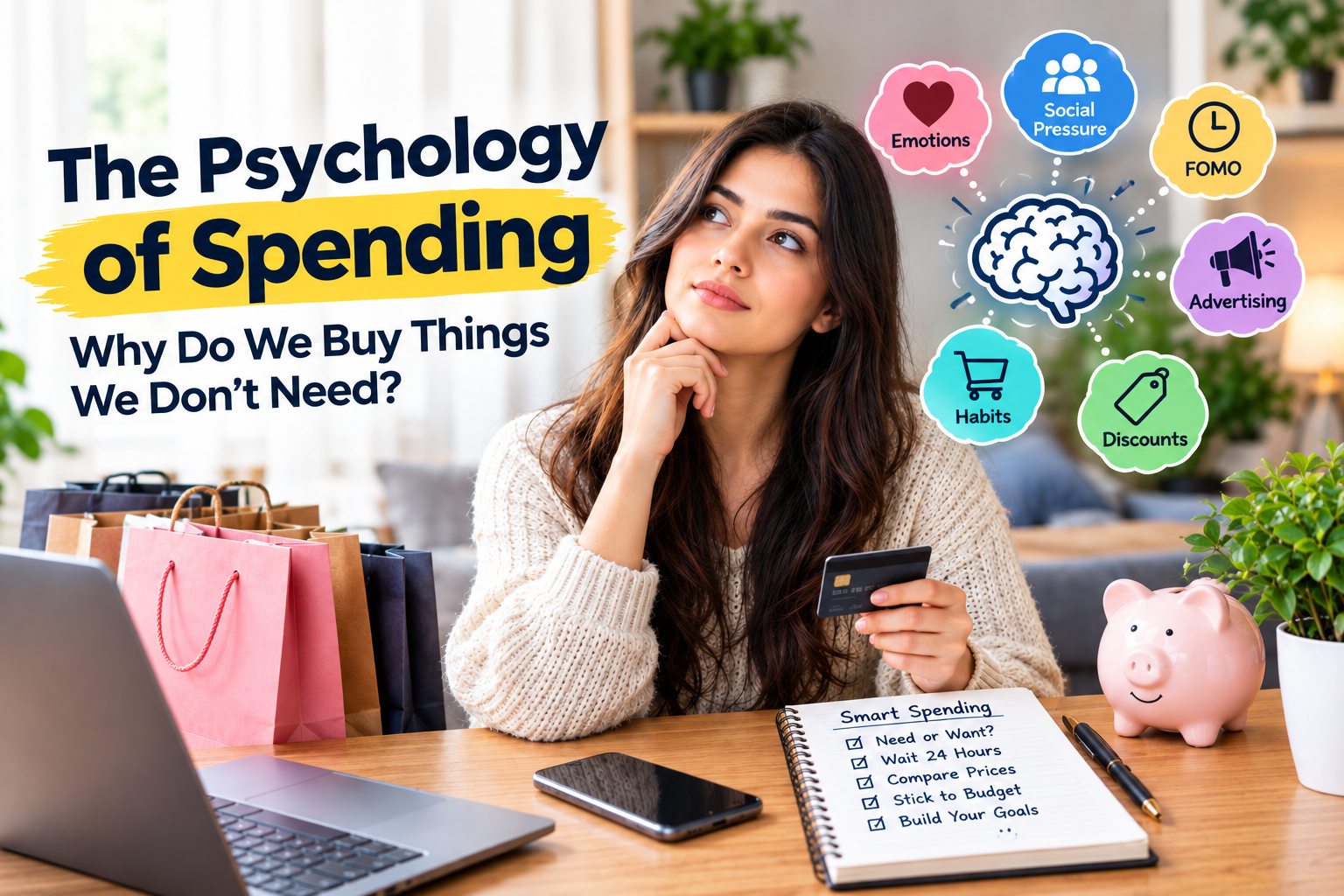
The Psychology of Spending: Why Do We Buy Things We Don’t Need?
SEO Title: The Psychology of Spending: Why We Buy Things We Don’t Need
Focus Keyword: Psychology of Spending
Meta Description: Discover the psychology of spending and learn why people buy things they don’t need, how emotions influence purchases, and how to make smarter spending decisions.
URL Slug: psychology-of-spending
Why Do We Buy Things We Don’t Need?
Have you ever opened your shopping app just to look around and somehow ended up buying something you never planned to purchase?
You are not alone.
Spending decisions are not always based on logic. Our emotions, habits, environment, social influences, advertising, and even the way a product is presented can affect what we decide to buy.
Understanding the psychology of spending can help you recognize these influences and make more intentional financial decisions.
The goal is not to stop spending money. It is to understand why you spend it.
What Is the Psychology of Spending?
The psychology of spending refers to the mental, emotional, and behavioral factors that influence how people make purchasing decisions.
Two people can have the same amount of money and make completely different spending choices.
One person may carefully compare prices before buying, while another may make an impulse purchase because of a limited-time offer.
This shows that spending is not purely a mathematical decision.
How Emotions Influence Spending
Emotions can play an important role in purchasing behavior.
People may spend money when they feel excited, stressed, bored, rewarded, socially pressured, or emotionally connected to a product.
For example, someone might purchase something after a difficult day because the purchase provides a temporary feeling of satisfaction.
This does not mean every emotional purchase is harmful. The important issue is recognizing when emotions are driving decisions that conflict with your financial goals.
7 Psychological Reasons We Buy Things We Don’t Need
| Psychological Factor | How It Can Influence Spending |
|---|---|
| Emotional Spending | Buying to change or reward a mood |
| Social Pressure | Purchasing because others have something |
| Scarcity | Fear of missing a limited opportunity |
| Discounts | Feeling that a lower price automatically means savings |
| Instant Gratification | Choosing immediate satisfaction |
| Advertising | Creating desire through persuasive messaging |
| Habit | Buying automatically without evaluating the need |
Understanding these patterns can make it easier to pause before making unnecessary purchases.
1. Emotional Spending
One of the most common examples of spending psychology is emotional spending.
A person might shop when feeling stressed, bored, excited, or disappointed.
The purchase may create a short-term feeling of pleasure, but that feeling does not necessarily last.
Before making an emotional purchase, try asking:
“Would I still want this tomorrow?”
A short pause can create enough distance between the emotion and the financial decision.
2. The Fear of Missing Out
The fear of missing out, often called FOMO, can influence buying behavior.
Phrases such as “limited time,” “last chance,” or “only a few remaining” can create a sense of urgency.
Scarcity can make an offer feel more valuable, even when the product itself has not changed.
Before buying because something appears limited, ask whether you actually needed it before seeing the offer.
3. Discounts Can Trick Our Perception
A discount can feel like an opportunity to save money.
But there is an important distinction:
Not spending $100 is different from buying a $100 product for $70 that you did not need.
If you spend $70 on something unnecessary simply because it was discounted, you have not necessarily saved $30.
You have spent $70.
This is one of the most important ideas in understanding the psychology of spending.
4. Social Influence
People naturally compare themselves with others.
Social media can make this effect even stronger because users constantly see products, lifestyles, restaurants, vacations, clothing, technology, and other purchases.
Seeing other people buy something can create the impression that you need it too.
But another person’s spending does not automatically make that purchase appropriate for your own financial situation.
5. Instant Gratification
Humans often prefer immediate rewards over delayed rewards.
This can influence everything from food purchases to entertainment, gadgets, subscriptions, and online shopping.
Saving money usually requires delaying consumption.
That is why developing the habit of waiting before non-essential purchases can be useful.
A simple rule can be:
Pause → Think → Compare → Decide.
6. Advertising Influences What We Want
Advertising is designed to attract attention and influence consumer behavior.
Modern advertising can use personalization, emotional storytelling, social proof, discounts, influencers, visual design, and behavioral data to make products more appealing.
This does not mean every advertisement is misleading.
It means consumers should recognize that advertising has a purpose: encouraging a purchase.
Understanding that purpose can make it easier to separate want from need.
7. Spending Can Become a Habit
Sometimes people purchase things without thinking about the decision.
A daily coffee, frequent food delivery, recurring subscription, or regular online shopping can become part of a routine.
A single purchase may seem small, but repeated spending can become significant over time.
Tracking recurring expenses can reveal habits that are easy to overlook.
Needs vs Wants: Why the Difference Matters
One useful way to improve money management is to separate needs from wants.
| Needs | Wants |
|---|---|
| Basic food | Frequent restaurant meals |
| Essential housing | Luxury upgrades |
| Necessary transportation | Optional vehicle upgrades |
| Basic utilities | Extra subscriptions |
| Essential healthcare | Non-essential purchases |
The distinction is not always absolute.
A product that is a “want” for one person may be an important need for another.
The goal is simply to understand the difference before spending.
How Social Media Affects Spending
Social media has changed consumer behavior.
People can discover products instantly through videos, influencers, recommendations, advertisements, and viral trends.
Repeated exposure can make a product feel familiar and desirable.
Social proof can also influence decisions. If thousands of people appear to like a product, a potential customer may assume that the product must be valuable.
Before purchasing something because it is trending, consider whether you would still want it if you had never seen it online.
Impulse Buying: How to Stop Unplanned Purchases
Impulse buying happens when a purchase is made without sufficient planning or consideration.
A few simple habits can reduce unnecessary impulse purchases:
- Wait before buying non-essential items.
- Compare prices from multiple sellers.
- Remove unnecessary shopping notifications.
- Create a monthly spending limit.
- Make a shopping list before going to a store.
- Review subscriptions regularly.
- Ask whether the purchase supports your financial goals.
These habits do not require you to stop enjoying your money.
They simply create more control over spending decisions.
The 24-Hour Rule
One simple strategy for reducing impulse spending is to wait 24 hours before making a non-essential purchase.
The purpose is not the exact 24-hour period.
The purpose is to create a gap between the initial desire and the final decision.
After waiting, you may discover that the product is still useful—or that the desire to buy it has disappeared.
How to Make Smarter Spending Decisions
Smart spending does not mean buying the cheapest product available.
It means making purchases that fit your needs, priorities, and financial situation.
Before purchasing something, ask yourself:
Do I need it?
Will I actually use it?
Can I afford it without disrupting my financial goals?
Would I buy it without the discount?
Am I buying it because I need it or because I feel pressured?
These questions can turn an automatic purchase into a conscious decision.
Psychology of Spending and Financial Goals
Your spending habits are connected to your larger financial goals.
If your goal is to build an emergency fund, start a business, invest for the future, or save for a major purchase, unnecessary spending can compete with those objectives.
This does not mean eliminating every enjoyable purchase.
Instead, create room for both enjoyment and financial priorities.
A realistic financial plan should be sustainable rather than extremely restrictive.
How to Create Better Spending Habits
Changing spending behavior usually happens gradually.
Start by tracking where your money goes.
Then identify patterns.
You may discover that your biggest issue is impulse shopping, subscriptions, eating out, social pressure, or frequent small purchases.
Once you identify the pattern, create one practical rule to address it.
Small behavioral changes can become stronger financial habits over time.
SEO Keywords for Psychology of Spending
Primary Focus Keyword:
- Psychology of Spending
Secondary Keywords:
- spending habits
- psychology of money
- emotional spending
- impulse buying
- consumer behavior
- money management
- spending behavior
- smart spending
- personal finance
- unnecessary spending
Long-Tail Keywords:
- why do we buy things we don’t need
- psychology behind spending money
- why people spend money emotionally
- how to stop impulse buying
- how emotions affect spending
- how to control unnecessary spending
- how to develop better spending habits
- why people buy things they don’t need
Use the focus keyword naturally in the introduction, selected headings, body content, SEO title, meta description, URL, and conclusion. Avoid keyword stuffing.
Frequently Asked Questions
Why do people buy things they don’t need?
People may purchase unnecessary items because of emotions, habits, advertising, social influence, discounts, scarcity, instant gratification, or impulse buying.
What is emotional spending?
Emotional spending occurs when feelings such as stress, boredom, excitement, or disappointment influence a purchasing decision.
How can I stop impulse buying?
Creating a waiting period, removing shopping triggers, setting spending limits, tracking expenses, and asking whether a purchase supports your financial goals can help reduce impulse buying.
Why do discounts make us spend more?
Discounts can create the perception that a purchase represents a financial gain. This can encourage people to buy products they would not otherwise have considered.
Does social media affect spending habits?
Yes. Social media can expose people to products, trends, influencers, advertisements, and social proof that may influence purchasing decisions.
Final Thoughts
The psychology of spending shows us that money decisions are about more than numbers.
Emotions, habits, advertising, social influence, and the desire for instant gratification can all affect what we buy.
Understanding these influences does not mean you have to stop spending.
It means you can become more intentional about where your money goes.
The next time you feel the urge to buy something you did not plan for, pause for a moment and ask:
“Do I actually need this, or did something make me want it?”
That simple question could change the way you think about spending.
Spend consciously. Save intentionally. Build your financial future one decision at a time.